non-realtime generative audio media
Program Notes:
This tool generates beats using a combination of Euclidean rhythms and substitution systems for ornamentation. The ranges and metric placements of Euclidean rhythms are hand-curated to best fit a variety of musical styles.
There is no training data and no machine learning involved. Various statistical measures of rhythms that approximate aspects of music perception are used to select from candidate renders, which are made at run time, based on a random seed.
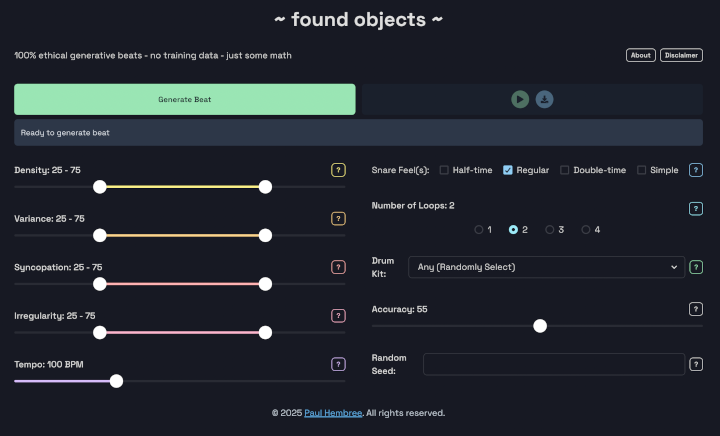
Density, variance, syncopation and irregularity are all correlated with perceived complexity. By adjusting these controls you should be able to find a range that best fits with your musical sensibilities.
Although the idea of "found objects" as art originates in the work of Picasso and Duchamp, my work here is closer to what is described in composer Tom Johnson's essay "Found Mathematical Objects" (2001).
Generating rhythms with Euclid's algorithm was described in "The Euclidean Algorithm Generates Traditional Musical Rhythms" (2005), but the technique is effectively the same as quantizing any tuplet to a different rhythmic resolution, a basic technique well known to algorithmic composers.
found objects is a Python application running in AWS Lambda, with a Javascript front end running in AWS Amplify.
History:
Premiere demonstration: Oct. 29, 2025
GameSoundCon 2025
Burbank Convention Center, Los Angeles, CA
Link: